What Is a QR Code? How QR Codes Work and What They Hold
A QR code is a square 2D barcode that stores a web address, text or other data in a grid of dark and light modules. A phone camera reads it and offers to open the link or show the content. This guide explains how QR codes work, what they can hold and how to scan one.
By the Barcode.codes editorial teamReviewed
What a QR Code Is
A QR code, short for Quick Response code, is a two-dimensional barcode: square modules in a square grid, found by the finder patterns at three of its corners.
What a QR Code Looks Like
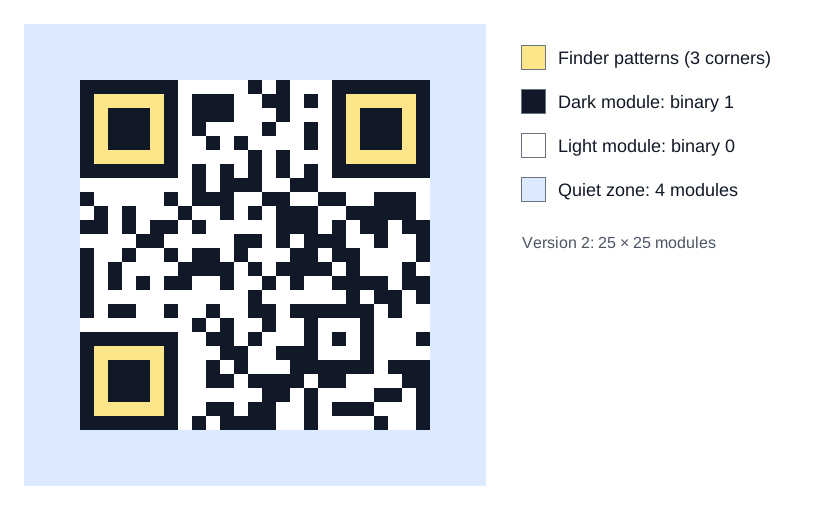
A QR code is 21 × 21 modules at version 1 and grows by four modules per side up to 177 × 177 at version 40. It needs a blank margin of four modules, the quiet zone, on every side.
A Standard Anyone Can Use
QR Code is defined by the international standard ISO/IEC 18004, and GS1 has adopted it for product data. A code made to the standard works with any reader that supports it, not only with the site that made it.
QR code vs barcode how a QR code differs from a 1D barcode and when to use each.
How Do QR Codes Work?
A QR code turns data into bits, adds error correction, and writes the bits as dark and light modules; a scanner finds the grid from the finder patterns and reads the bits back.
From Characters to Modules
QR Code has modes for digits, for capital letters with digits and nine symbols, and for bytes of any text, and the fewer kinds of characters, the more fit. At version 40 with the lowest error correction a QR code holds 7,089 digits, 4,296 capitals and digits, or 2,953 bytes.
A dark module is a binary 1 and a light module a 0. The encoder picks the smallest version that holds the data at the chosen error correction level, which is why a longer web address gives a denser code.
Error Correction
A QR code adds Reed-Solomon codewords, the same kind of error correction used on music CDs, so it can be read when part of it is dirty or missing. DENSO WAVE explains that correcting one codeword takes two extra ones, and gives the strength as a share of all codewords, from about 7% to 30%.
QR code generator lets you choose the error correction level and shows the version.
Read at Any Angle
The three finder patterns show the scanner where the code is and which way it faces, so a QR code reads at any rotation and even mirrored. The standard also allows light modules on a dark background, as an optional feature.
What a QR Code Can Hold
A QR code holds text, and phones act on text written in known formats: a web address opens a page, and other formats join a Wi-Fi network, save a contact or start a message.
| Content | What the code holds |
|---|---|
| Web address | https://barcode.codes/ |
| Wi-Fi network (ZXing format) | WIFI:T:WPA;S:Cafe Guest;P:coffee-2026;; |
| Contact card (vCard 3.0, RFC 2426) | BEGIN:VCARD … END:VCARD |
| Email (RFC 6068) | mailto:support@barcode.codes |
| Phone call (RFC 3966) | tel:+12125550100 |
| Text message (RFC 5724) | sms:+12125550100 |
| Plain text (no format) | Hello from Barcode.codes |
QR code generator for Wi-Fi writes the Wi-Fi format for you, escaping special characters.
vCard QR code generator builds the contact card from a form.
How to Scan a QR Code With a Phone
Point the phone's camera at the code and tap the link or the result that appears; no separate app is needed on an iPhone.
- Open the Camera app, or the Scan Code control in Control Center on an iPhone.
- Hold the phone so the whole code, with its blank margin, is in the frame.
- Check the address or the result shown, then tap it to open it.
The Barcode.codes scanner reads QR codes in the browser on phones and computers. It shows a link in full, with its host, and never opens it by itself.
QR code scanner reads QR codes with your camera.
QR code reader reads QR codes from a photo or a screenshot.
Frequently Asked Questions
What Does QR Stand For?
Quick Response. Apple's iPhone guide calls them Quick Response (QR) codes, and the encoder's documentation lists Quick Response Code as the symbology's full name.
How Much Data Can a QR Code Hold?
Up to 7,089 digits, 4,296 capitals and digits, or 2,953 bytes of text, in the largest version with the lowest error correction. Most codes hold far less, because a dense code is harder to scan from a distance.
Do QR Codes Expire?
The code itself does not: its content is written in the pattern. A code that holds a link stops being useful when the linked page goes away, including a short link whose service later shuts down.
Is It Safe to Scan a QR Code?
Scanning only reads the content; the risk is in what you open next. Read the address before you tap it: phones and the Barcode.codes scanner show it first.
Can a QR Code Have Colors?
Yes, if the dark modules stay clearly darker than the light ones. The Barcode.codes generator estimates the contrast of your colors and refuses pairs below 20%.
Sources
The facts in this guide come from these sources, checked on October 8, 2026 from the copies saved on October 4, 2026.
GS1 General Specifications, Release 26.0, ratified January 2026 defines the GS1 identification keys, barcodes and Application Identifiers; the text names the sections used.
DENSO WAVE: Information capacity and versions of QR Code describes versions 1 to 40 and how the version is chosen for the data.
DENSO WAVE: QR Code error correction feature gives the share of codewords each QR error correction level can restore.
Apple iPhone User Guide: Scan a QR code describes reading QR codes with the iPhone Camera app.
BWIPP: QR Code symbology reference documents the QR Code encoder the generator uses, its standards and the automatic version choice.
ZXing: Barcode Contents lists the content formats phones recognize in QR codes, such as web addresses, Wi-Fi and contacts.
Related Barcode Guides
- Data Matrix vs QR code
Size, capacity and error correction of the two 2D codes.
- How do barcodes work?
How bars and modules hold data and how scanners read them.
- Types of barcodes
Every 1D and 2D barcode type, what it holds and where it is used.
- What is a barcode?
What a barcode is, what it holds and where it is used.
- How to read a barcode
What the digits mean and how to read the bars by eye.