SKU vs UPC: The Difference Between SKU and UPC Codes
SKU vs UPC: a UPC is a 12-digit product number from GS1 that stays the same in every store that sells the product, while a SKU is a code a business makes up to track its own stock. This guide compares the two, explains when you need each, and shows how to put a SKU in a barcode.
By the Barcode.codes editorial teamReviewed
What Is the Difference Between a SKU and a UPC?
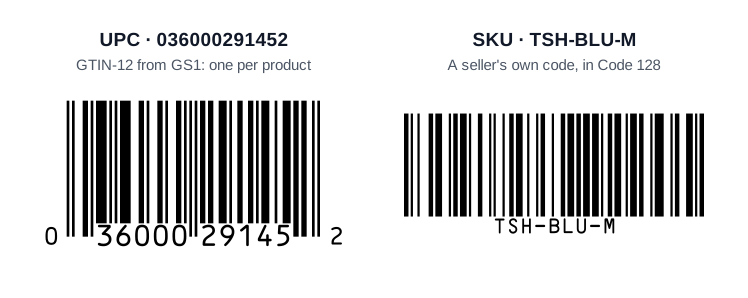
A UPC is a GS1 product number that stays the same wherever the product is sold; a SKU is a code a business makes up for its own stock, and another business may use a different one for the same product.
| Property | UPC | SKU |
|---|---|---|
| Who assigns it | The brand, from a GS1 Company Prefix or a single GTIN bought from GS1 US | Each business that stocks the item |
| Format | 12 digits, the last one a check digit | Any letters and digits the business chooses |
| Same in every store | Yes: one GTIN-12 per product | No: each business has its own |
| Scanned at retail checkouts | Yes, as a UPC-A or UPC-E | No |
| Usual barcode | UPC-A | Code 128, or none |
When You Need a UPC
You need a UPC, or another GTIN, when a retailer scans your product at the checkout or lists it by its GTIN.
GS1's standard requires an EAN/UPC barcode with a GTIN on items scanned at retail checkouts, and a GTIN must be unique to one product: a new size, flavor or color gets its own. Retailers and marketplaces set their own rules on top, so check what each one asks for.
What is a UPC code? the 12 digits, the check digit and how to get UPC numbers from GS1 US.
When You Use a SKU
A SKU is for your own systems: counting stock, picking orders and telling variants apart, in a form your staff can read.
Building a SKU
A SKU can be built from parts you recognize, such as type, color and size: TSH-BLU-M for a blue T-shirt in medium. No standard sets the format, so pick one, write it down and use it for every product.
Keep SKUs to capital letters, digits and hyphens if you want to print them as barcodes; Code 128 holds all ASCII characters, but Code 39 only capitals, digits and a few symbols.
Internal Numbers in the GS1 System
GS1 also reserves numbers for use inside a company, such as 13-digit numbers starting with 04 or UPC-A numbers starting with 4. GS1 limits them to a company or another restricted environment, so they cannot stand in for a UPC on products sold through retailers.
How to Put a SKU in a Barcode
Print the SKU in a Code 128 barcode for your shelves, bins and labels, and keep the UPC-A as the product's retail barcode.
- Write down your SKU format and the SKU of each product.
- Make a Code 128 barcode for each SKU, or many at once from a spreadsheet.
- Print the labels and scan one before you label the stock.
Do not put a SKU in a UPC-A barcode: a UPC-A holds only digits, and a number you make up is not a GTIN licensed from GS1.
Code 128 barcode generator makes a barcode for any SKU with letters, digits and symbols.
Barcode label generator prints SKU labels on standard sheets.
Using a SKU and a UPC Together
A seller that sells through retailers keeps both: the UPC on the package for the stores, and its own SKU in its stock system, matched one to one.
Store the UPC as a field of each SKU in your inventory system, so a scan of the package finds your stock record. Because each GTIN stands for one product, one UPC should match one SKU in your own system, even when another seller gives the same product a different SKU.
Frequently Asked Questions
Is a SKU the Same as a UPC?
No. A UPC is a GTIN-12 from the GS1 system, the same for every seller of the product, while a SKU is a seller's own code that other sellers do not know.
Can I Use the UPC as My SKU?
Yes, a business can use the 12 digits as its own code. The reverse does not work: a SKU you make up is not a UPC, because UPC numbers come from GS1.
Can One Product Have Several SKUs?
Yes. Every seller and warehouse can give the same product its own SKU, while the UPC on the package stays the same for all of them.
Which Barcode Type Is Best for a SKU?
Code 128 is the usual choice: it holds letters, digits and symbols and packs digits two to a character. Code 39 also works for SKUs made of capitals, digits and a few symbols, but it makes a wider barcode.
Sources
The facts in this guide come from these sources, checked on October 8, 2026.
GS1 General Specifications, Release 26.0, ratified January 2026 defines the GS1 identification keys, barcodes and Application Identifiers; the text names the sections used.
GS1 US: How to get a UPC barcode describes the single GTIN and GS1 Company Prefix options and their limits.
BWIPP symbology references (Code 128, Code 39, Data Matrix, PDF417, Aztec Code, MaxiCode) documents the character sets, sizes and standards of the encoder the generator uses.
Related Barcode Guides
- What is a UPC code?
The 12 digits, the check digit and how to get one.
- What is a GTIN?
The product number inside every retail barcode.
- EAN vs UPC
The difference between UPC-A and EAN-13, and how to convert.
- Types of barcodes
Every 1D and 2D barcode type, what it holds and where it is used.
- How to read a barcode
What the digits mean and how to read the bars by eye.