Barcode for Food Products: How to Get One in the US
A barcode for food products in the US is usually a UPC-A that carries a GTIN your company licenses from GS1 US, one for each flavor, size and package. Cases usually add a GS1-128 with the batch and expiry date, and 2D codes are coming with Sunrise 2027. This guide shows how to get and check them.
By the Barcode.codes editorial teamReviewed
Which Barcode a Food Product Needs
In US grocery, each item carries a UPC; cases usually carry a GS1-128 with the batch and the expiry date; and GS1 US expects 2D barcodes to become the new standard with Sunrise 2027.
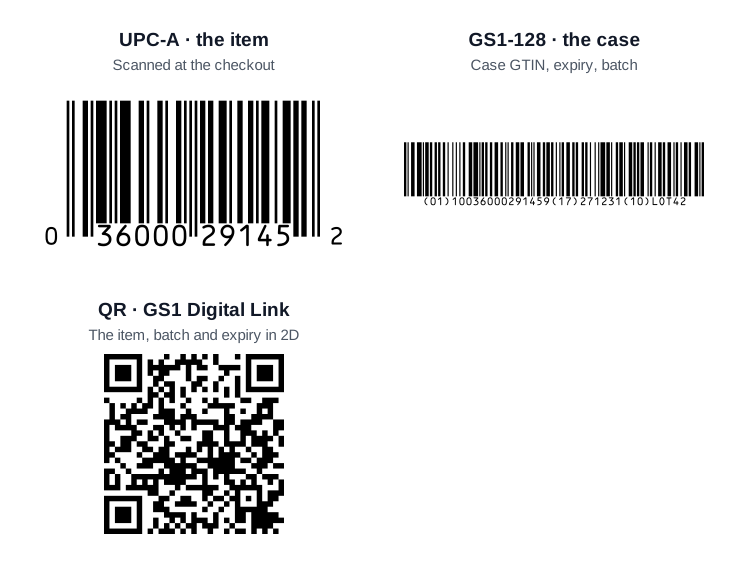
The UPC on the Item
GS1 US calls the UPC the barcode used on everyday groceries. It holds only the product's GTIN-12; the name, price and stock of the product live in the store's system, which looks the number up.
GS1-128 on Cases and Pallets
GS1-128 barcodes are usually used on higher levels of packaging, GS1 US says, because they can hold the batch or lot, a serial number or the expiry date next to the GTIN. In the diagram, (01) is the case GTIN, (17) the expiry date as YYMMDD and (10) the batch.
2D Barcodes and Sunrise 2027
GS1 US expects 2D barcodes such as QR codes to become the new standard with Sunrise 2027, carrying more information than the UPC. A 2D code with GS1 data can hold the GTIN, the batch and the expiry date that a UPC cannot.
GS1 Sunrise 2027 explained what the 2027 date means for stores and brands, and what to print now.
How to Get a Barcode for a Food Product
In the US, license the number from GS1 US first, one for each product variation, then draw it as a UPC-A and check it before you print.
- Count your variations: each flavor, size and package of a product needs its own barcode.
- Choose a single GS1 US GTIN for a few products, or a GS1 Company Prefix for more products and for cases and pallets.
- Check out with GS1 US; it sends access to its member center and to GS1 US Data Hub, where you assign the numbers.
- Draw each number as a UPC-A, check the digits and print a test label before the packaging run.
One Barcode for Each Variation
GS1 US counts every variation as a separate product: three sizes in three flavors are nine barcodes, and a new package of the same food is another. Plan the count before you apply, so you license enough numbers.
A Single GTIN or a GS1 Company Prefix
| Option | Single GS1 US GTIN | GS1 Company Prefix |
|---|---|---|
| Numbers | One GTIN | A block, by capacity |
| Price | $30, no annual renewal fee | By capacity, with yearly membership renewal |
| Cases and pallets | Not listed; not available for mixed cases | Yes, higher levels of packaging |
| Not available for | Variable measure products, mixed cases, coupons, pharmaceuticals | See GS1 US for regulated products |
Food sold by weight is a variable measure product, for which the single GS1 US GTIN is not available. Ask GS1 US which number fits it.
Food Barcodes and Traceability
Barcodes with batch and date data help a food business find and pull the right stock in a recall; GS1 US points to the FDA's FSMA Rule 204 for the records some foods need.
- FSMA Rule 204: GS1 US notes that the FDA requires reporting of specific Critical Tracking Events and Key Data Elements under the rule.
- Batch and dates: GS1-128 on cases carries the batch or lot and the expiry date, so a scan records them without typing.
- Locations: a Global Location Number (GLN) identifies a place, such as a farm, a distribution center or a restaurant, in the records.
A barcode does not make a food business compliant on its own: the rule is about the records kept and shared. Read GS1 US's FSMA Rule 204 resources and the FDA's text for what applies to your foods.
Check the Number Before You Print
Check the GTIN's last digit before the barcode goes on packaging: it is calculated from the other digits, so most typing errors in the number show up as a wrong check digit.
Try it: check digit calculator
11 digits without the check digit.
Check digit
2
036000291452
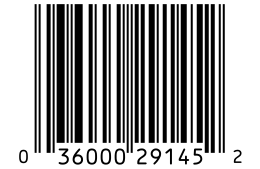
Show the calculation
| # | Character | Value | Weight | Product |
|---|---|---|---|---|
| 1 | 0 | 0 | ×3 | 0 |
| 2 | 3 | 3 | ×1 | 3 |
| 3 | 6 | 6 | ×3 | 18 |
| 4 | 0 | 0 | ×1 | 0 |
| 5 | 0 | 0 | ×3 | 0 |
| 6 | 0 | 0 | ×1 | 0 |
| 7 | 2 | 2 | ×3 | 6 |
| 8 | 9 | 9 | ×1 | 9 |
| 9 | 1 | 1 | ×3 | 3 |
| 10 | 4 | 4 | ×1 | 4 |
| 11 | 5 | 5 | ×3 | 15 |
| Sum | 58 | |||
Nearest multiple of ten at or above 58 is 60: 60 − 58 = 2
A correct check digit shows the number is well formed, not that it is licensed to your company. GS1 US Data Hub shows the numbers your license covers.
UPC barcode generator draws a UPC-A from your GTIN with the size and margins for print.
GS1-128 barcode generator draws case labels with the GTIN, batch and expiry date, checked by GS1's syntax engine.
Frequently Asked Questions
Can I Make My Own Barcode for a Food Product?
You can draw any barcode, but a UPC that stores scan needs a GTIN licensed to your company by GS1 US. A generator draws the number; it does not issue one.
How Much Does a Food Barcode Cost in the US?
GS1 US listed a single GS1 US GTIN at $30 with no annual renewal fee on October 9, 2026; a GS1 Company Prefix is priced by capacity. GS1 US may change its prices, so check its site before you buy.
Does Each Flavor or Size Need Its Own Barcode?
Yes. GS1 US treats every variation as a separate product, so each flavor, size and package gets its own GTIN and barcode.
What Do the Numbers on a Food Barcode Mean?
They are the GTIN: the company's prefix, the item reference and a check digit. They do not encode the price or the ingredients; the store's system looks those up.
Sources
The facts in this guide come from these sources, retrieved on October 9, 2026; the check digits are calculated with the site's calculator and by hand.
GS1 US: GS1 Standards for Foodservice and Retail Grocery describes the UPC on groceries, GS1-128 on higher packaging levels, 2D barcodes with Sunrise 2027 and FSMA Rule 204 traceability; checked October 9, 2026.
GS1 US: How to Get UPC Barcodes for Products describes one barcode per product variation, the single GS1 US GTIN and the GS1 Company Prefix, and their limits; checked October 9, 2026.
GS1 General Specifications, Release 26.0, ratified January 2026 defines the GS1 identification keys, barcodes and Application Identifiers; the text names the sections used.
Related Barcode Guides
- What is a UPC code?
The 12 digits, the check digit and how to get one.
- What is a GTIN?
GTIN-8, -12, -13 and -14 and their barcodes.
- GS1 Sunrise 2027 explained
2D barcodes at checkout and what to print.
- GS1 Application Identifiers list
Every AI with its format, such as (10) and (17).
- SCC-14 barcode
The 14-digit carton number and its ITF-14.